
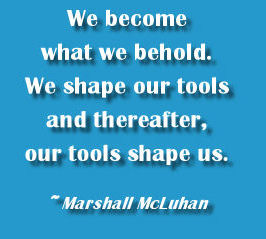
 Last week, I came upon a quote by philosopher, writer and educator Marshall McLuhan that resonated with me: “We become what we behold. We shape our tools and thereafter, our tools shape us.”
Years ago, for a conference I organized, I was working with Doug Goodman, an uber-talented photographer who works for Ad Age and a host of other high-profile clients. Our organization always relied upon him to photograph the staff and chronicle the litany of meetings we held throughout the year.
I was surprised that, when he heard a brief description of one employee, without even hearing the man’s name, he was immediately able to identify the individual.
I realized, at that moment, how looking through the lens of a camera honed a photographer’s vision and perspective. In Doug’s case, since he specializes in portraits and events, the camera gives him a particular view on people and how their personalities, skills and idiosyncrasies are reflected on their faces and conveyed through their body and the clothing they choose to wear. In all his shoots, his camera functions as a tool to “see into his subject’s soul” and capture the essence of the individual. He excels at that, and his camera functions as the tool that shapes his world, which is filled with friends, beauty, light and intelligence.
Now I juxtapose the camera with a very different type of tool.
In recent weeks, many across the nation have been outraged at the shooting death of the unarmed youth Michael Brown Jr. It has been the catalyst to a widening chasm filling, from both sides, with a fermenting brew of distrust, fear, suspicion and outrage. For the community’s sake, I hope this event does not engender the long-term troubling effects and insidious repercussions I fear.
If you look at an event such as this through McLuhan’s perspective, I can’t help but think that the tools issued to police – guns and tazers, pepper spray and tear gas, handcuffs and bulletproof vests – shape their perspective of the world and the community around them as a darker, more sinister place where weapons are needed for everyday life.
What if police officers were given another type of “tool?”
I’ve recently read articles about the reduction in police violence within communities in which officers are required to wear cameras on their uniforms. That’s great if it helps, but it doesn’t get at the root of the problem, which I see as a “them” and “us” mentality between officers and residents.
What if a police officer’s arsenal of tools for protecting the community was augmented to include volunteer time? Volunteer time, not in the community in which they live, but within the community in which they serve. Suppose 5% of the time for which they are paid was given back in the form of service to a volunteer program of their choice…at a rec center, for a reading program, to a youth sports program, in a soup kitchen, at a drug rehab center or some other initiative that contributed to the welfare of the community in which they serve?
No doubt, many police officers do volunteer work. But what if their experience on their beat was shaped by their paid volunteer service, within the footprint of their beat, where they had the opportunity to get to know residents on a personal level…to know their interests and hobbies, their families and friends, the joys and tragedies of the lives of those they are paid to protect? What if each officer who is paid for a 40 hour work week were encouraged to commit 2 hours of each week to paid volunteer service within his community, from day one of working there?
Some may say this is a naïve proposal, but in my personal experience, when you really get to know someone — especially people who are very different from those you encounter in your daily life — it’s hard to see them as the enemy. From my perspective, familiarity breeds understanding, compassion and often, friendship, rather than the contempt suggested by the old idiom.
There are many objections that could be raised in opposition to this idea: from budget restrictions and taxpayer objections, to concerns over officer safety (especially in communities where there is a long history of distrust between residents and the police force).
But I’d like to throw down the gauntlet and challenge communities to try it.
If the police force in your community already does this, or if you as an officer already commit volunteer time within the community your serve, I’d be interested in hearing if it has changed your perspective, and if so, how?
As an addendum to Marshall McLuhan’s quote, I add this plea:
Let our tools not be those of darkness and destruction, but of light and learning. That will make all the difference in humanity’s outcome.
 Out on a Limb